Thinking about the unbuiltOur blog
Interactive Showroom vs. 360° Virtual Tour: Real Differences and When Each Makes Sense
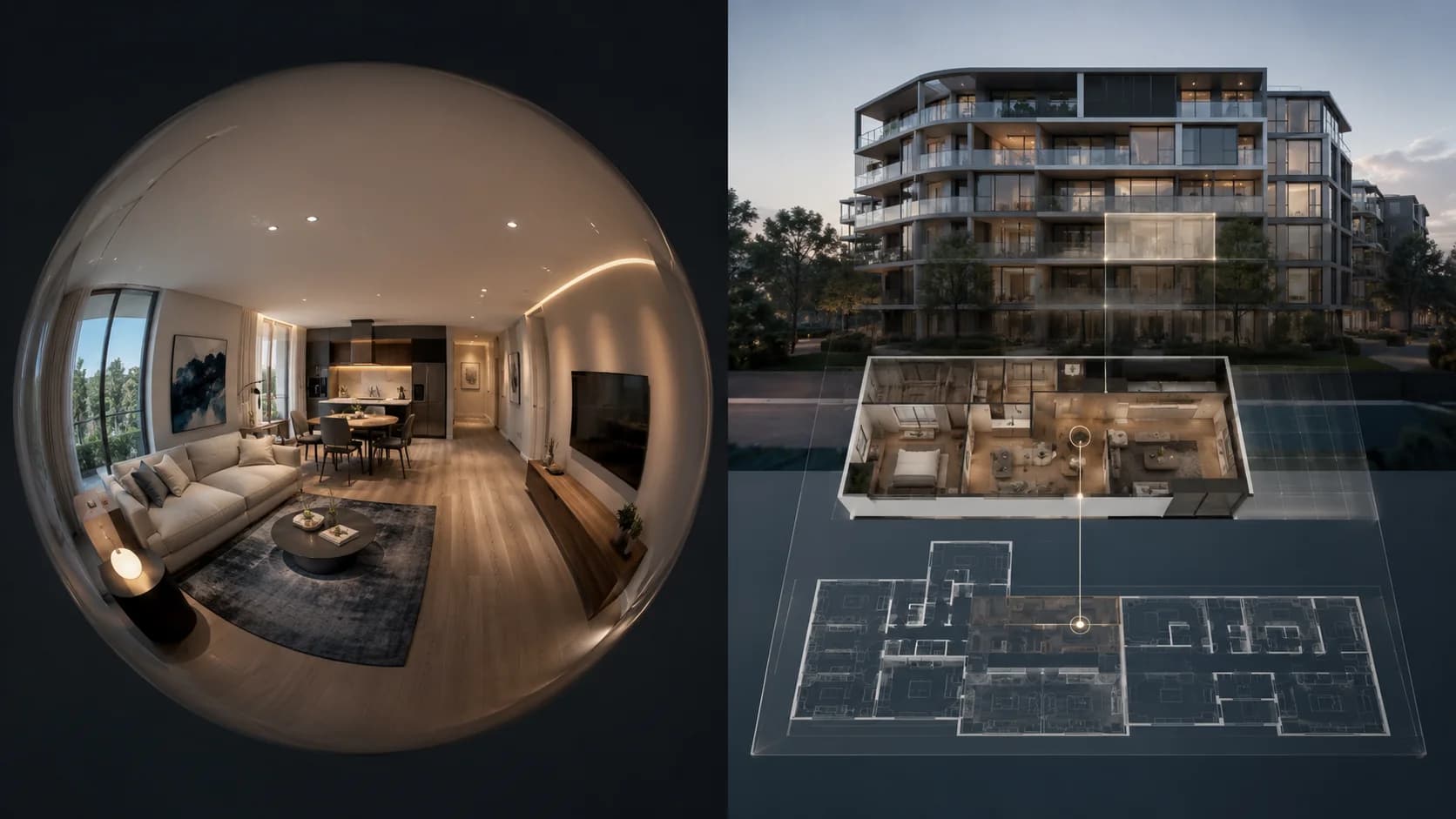
TL;DR. A 360° virtual tour and an interactive showroom are used interchangeably in the real estate market, but they're different things. A 360° tour is an immersion technique within a specific space (a unit, a room, an amenity): you enter, look around, leave. An interactive showroom is a complete commercial environment where the buyer tours the building, navigates between floors, explores units, checks availability, and submits inquiries. A 360° tour can be a piece within an interactive showroom, but a 360° tour alone is not equivalent to a showroom. This guide covers what each does, when each makes sense, and how they integrate to present a pre-construction project.
Why they're so often confused in the real estate market
The confusion between 360° virtual tours and interactive showrooms runs across the industry and has three concrete causes.
The first is vocabulary. Market providers use the terms interchangeably, stacking words like "immersive," "virtual," "interactive," and "3D" onto products that often do very different things. A developer can receive three quotes that use the same language and deliver radically different results.
The second is visualization. Both categories share aesthetics: enveloping imagery, clickable hotspot navigation, a "you-are-here" sensation. At first glance, a 360° tour demo and an interactive showroom demo can look alike. The difference appears when you try to use either as a real commercial tool, not just a visual asset.
The third is historical. The 360° virtual tour was, for a long time, the closest thing to "selling pre-construction immersively" the market could offer. Many developers and brokers have reference to 360° tours from years back and assume that any "interactive" proposal is an improved version of the same concept. It often isn't: they're frequently distinct categories.
At Flowing we run into this confusion often: developers evaluating an interactive showroom proposal and comparing it to a 360° tour quote, assuming they're measuring the same thing. They aren't. Clarifying the difference is what enables an informed decision.
What a 360° virtual tour is (operational definition)
A 360° virtual tour is an immersion technique within a space. It's built with photography or spherical renders covering 360 horizontal degrees and 180 vertical degrees of a room. The user enters that panoramic image and can look freely in any direction, as if standing inside.
The basic unit of a 360° tour is the space: a room, a living area, an amenity, a view. To connect multiple spaces, the system uses hotspots (clickable points that lead to the next space).
What a 360° tour does well:
Immersion within a specific space. It lets the user feel real dimensions, ceiling height, the relationship between rooms.
Showing a finished unit or model apartment, especially useful for rentals or sales of already-built properties.
Presenting an amenity (pool, gym, rooftop) with a sense of presence.
Working as a modular piece, easy to embed in a website or post.
What a 360° tour doesn't solve:
It doesn't show the building's context: the user is inside a space but doesn't understand how it relates to the rest of the project.
It has no floor navigation or unit comparison.
It includes no commercial status: the user doesn't know if the unit they're viewing is available, reserved, or sold.
It doesn't capture leads in a structured way or attribute inquiries to brokers.
It isn't usefully indexable on Google: each panorama is visual content that search engines process only partially.
This isn't a criticism of the 360° tour as a technique. It's a good technique for what it's designed for. The problem appears when it's used for something it doesn't solve: selling a pre-construction real estate project.
What an interactive showroom is (operational definition)
An interactive showroom is a digital commercial environment where the buyer tours a complete project, not a single space. It's the difference between entering a room and entering a building. We cover the full definition of this category in the complete guide to virtual real estate showrooms, but here it's worth describing in relation to the 360° tour.
The basic unit of an interactive showroom is the project: the entire building, with its exterior, floors, units, amenities, location, real-time commercial availability, lead capture, and sales team. All connected within a single experience.
What an interactive showroom does:
Exterior building tour with multiple views and cinematic transitions between them.
Floor navigation with floor plan and visible commercial status over each unit.
Complete unit file: interior render, 2D plan, square footage, rooms, orientation, price, status, downloadable material.
Internal immersion through 360° tours within each unit when the project justifies it. This is where the 360° appears as a piece, not as the whole product.
Lead capture with attribution to the broker who brought each visitor.
Operational backoffice so the sales team can update prices, availability, and statuses without depending on an external provider.
Project's own domain, indexable on Google, with unit-level SEO.
Flowing sits exactly in this category. It's an interactive showroom developed by LZ Render that integrates all the layers above into a single experience, with 360° tours embedded when applicable, but understanding that the 360° tour is a piece of the showroom and not its substance.
The distinction matters when comparing proposals: a 360° tour provider and an interactive showroom provider solve different problems, even if they speak the same commercial language.
Point-by-point comparison: 360° virtual tour vs. interactive showroom
The most direct way to visualize the difference is to go dimension by dimension. These are the ten areas most developers need to weigh when choosing between one and the other.
Basic unit.
360° virtual tour: the space (room, area).
Interactive showroom: the complete project (building).
Exterior building tour.
360° virtual tour: no.
Interactive showroom: yes, with cinematic transitions.
Floor navigation.
360° virtual tour: no.
Interactive showroom: yes, with floor plan and unit status.
Unit comparison.
360° virtual tour: no.
Interactive showroom: yes, within the same experience.
Real-time availability.
360° virtual tour: no.
Interactive showroom: yes, updatable from backoffice.
Lead capture with broker attribution.
360° virtual tour: no.
Interactive showroom: yes, with tracking codes per broker.
Project's own domain.
360° virtual tour: usually no.
Interactive showroom: yes, with managed SSL.
Google indexability.
360° virtual tour: limited.
Interactive showroom: yes, at unit level.
Mobile experience.
360° virtual tour: yes, with navigation limitations.
Interactive showroom: yes, optimized with touch controls.
Operational maintenance.
360° virtual tour: depends on provider.
Interactive showroom: self-service from backoffice.
This comparison isn't exhaustive, but it covers the most important decisions a developer makes when evaluating proposals. The quick conclusion: the 360° tour is a visual piece; the interactive showroom is a complete commercial operation.
Why a 360° tour alone isn't enough to sell a pre-construction project
This is the practical question that matters: if a developer already has a 360° tour of the model apartment, do they need an interactive showroom? The short answer is yes, and it's worth understanding why.
In pre-construction sales, the buyer doesn't purchase an isolated apartment: they purchase a position within a building that doesn't yet exist. The decision includes factors a 360° tour can't cover:
Building context. The buyer needs to see the project from outside, understand its scale, its volume, its relationship to the environment. A 360° tour inside a unit doesn't show the building. The buyer ends up standing in a room without knowing where that room is.
Unit comparison. In a project with multiple unit types, the buyer needs to compare options: which orientation, which floor, which price, which associated amenities. Individual 360° tours per unit fragment the decision: opening separate tours, mentally remembering differences, losing the thread.
Commercial status. An isolated visual piece doesn't tell the buyer which units are available. The most common frustration in pre-construction sales is falling in love with a unit that's already reserved. An interactive showroom shows status in real time; a 360° tour doesn't.
Lead capture with context. When a buyer inquires from a standalone 360° tour, the sales team receives a generic email. When they inquire from an interactive showroom, the team knows which units they viewed before, how long, what they downloaded. The conversation starts informed.
Construction progress. As construction advances, the buyer wants to verify progress. A 360° tour of the model apartment is frozen at the moment of its production. An interactive showroom updates photos, progress percentage, and timeline from the backoffice.
Together, these five factors explain why a standalone 360° tour leaves the buyer with questions the sales team ends up answering manually. That's inefficiency and operational cost. An interactive showroom absorbs those questions before the lead inquires.
When a 360° virtual tour makes sense
This isn't an article against 360° tours. It's a useful technique for the cases it was designed for. Four scenarios where a standalone 360° tour makes sense:
Already-built unit for sale or rent. When the property physically exists and the task is showing it remotely, a 360° tour solves the problem without needing a larger environment. It's the classic case of premium short-term rentals or sales of high-value resale properties.
Single space like a commercial location. A space for retail, office, or hospitality, for sale or rent. It's a single space, no building to tour, no units to compare. The 360° tour is the correct solution.
Model apartment of a small project with a limited budget. If the project has 4 or 6 identical units and a single finished model, a 360° tour of the model can be enough as a complement to a traditional brochure.
As a piece within a larger showroom. The most sophisticated use of the 360° tour is embedded within an interactive showroom, as an immersion file for each unit or amenity. Here the 360° tour contributes what it knows how to do (immersion within a space) and the showroom contributes the rest (tour, comparison, availability, leads).
Outside these four scenarios, the standalone 360° tour falls short of the demands of pre-construction sales for a residential project with multiple units.
When an interactive showroom makes sense
The interactive showroom is the right category when the commercial problem exceeds a single space. Five scenarios where the proposal is calibrated exactly for the case:
Pre-construction residential projects. The buyer has nothing physical to visit. Visual presentation is the central commercial asset. The interactive showroom is the closest thing to the finished building the developer can offer. The complete guide to virtual real estate showrooms goes deeper into which types of projects benefit most.
Projects with multiple units and unit types. Wherever comparison is needed, wherever the buyer needs to understand options, the interactive showroom organizes the comparison. The more complex the inventory, the higher the return.
High tickets. When each unit is worth what it's worth in premium projects, the presentation has to match. A fragmented visual piece lowers the project's perceived value and, by extension, its price. The interactive showroom sustains the premium perception.
Sales teams with external brokers. The broker needs material to distribute. A link to the showroom works much better than a PDF, not only because it's more complete, but because it automatically attributes the inquiry to the broker who shared it.
Projects where brand matters. When the developer is building brand identity through the project, the showroom living on the development's own domain reinforces that identity. A 360° tour hosted on an external platform doesn't.
At Flowing we work exactly with this project profile: pre-construction developments, multiple units, high tickets, premium perception sought. The interactive showroom doesn't apply to every real estate project, but when it applies, it moves the commercial needle clearly.
How they integrate: one doesn't replace the other
The most useful question isn't "360° tour or interactive showroom?". It's "how do they integrate to present the project better?".
In a well-built interactive showroom, 360° tours appear as a piece within each unit. The buyer tours the building from outside, navigates between floors, picks a unit, and within that unit's file finds a 360° tour that lets them enter the space and look around. There the 360° tour contributes what it knows how to do (immersion) without having to carry what it doesn't solve (context, availability, leads).
The same principle applies to amenities. A 360° tour of the pool or rooftop within the showroom is valuable because the buyer already understands where that pool sits within the project. The standalone 360° tour, without building context, loses force.
In Flowing projects, 360° tours are embedded within the showroom as an optional immersion layer. They're not the product: they're a piece that enriches the product when the development justifies it.
The correct reading isn't choosing between one and the other. It's understanding that one is a visual technique and the other is a commercial operation, and combining them where it makes sense.
Frequently asked questions
Does a 360° virtual tour work for selling a pre-construction project?
It works as a complement, not as a main piece. To sell a pre-construction project, the buyer needs to see the building in context, compare units, check availability, and submit inquiries. A 360° tour only covers immersion within a specific space, usually the model apartment. For the rest, it falls short. An interactive showroom covers all those layers and can include 360° tours as an internal piece.
How much more does an interactive showroom cost than a 360° virtual tour?
It depends on scope, but generally an interactive showroom is an investment several times higher than a standalone 360° tour, because it includes complete visual production of the building, floors, units, amenities, operational backoffice, and own domain. The cost difference reflects the scope difference: a 360° tour solves one piece, a showroom solves the complete commercial operation.
Can I start with a 360° tour and migrate to a showroom later?
Yes, it's a valid path for small projects or developers who want to test before committing to a complete showroom. However, it's worth evaluating total cost: investing first in a 360° tour and then in a complete showroom usually costs more than going straight to a showroom from the project's launch, where presentation has the biggest impact on pre-sales.
Do 360° tours look good on mobile?
Yes, 360° tours work on mobile, although touch navigation has more friction than on desktop. For projects where most traffic comes from mobile (over half in real estate), the interactive showroom is better optimized because it integrates specific touch controls and the complete experience is adapted to small screens.
What happens to existing visual content if I move to an interactive showroom?
Existing renders, videos, plans, and 360° tours can be integrated within the showroom as internal pieces. At Flowing we work with the assets the developer already has when they're of sufficient quality, or produce from scratch when needed. Nothing previously invested is discarded if it has value.
Is a 360° tour indexable on Google?
In a limited way. Traditional 360° tour proposals work as interactive visual content that search engines process partially: they can index the page that contains it, but not the internal images or commercial information. A well-built interactive showroom renders project information in a way Google can read at unit level, allowing each unit to appear in organic searches.
Read next
Virtual Real Estate Showroom: Complete Guide for Developers