Thinking about the unbuiltOur blog
Virtual Real Estate Showroom: Complete Guide for Developers
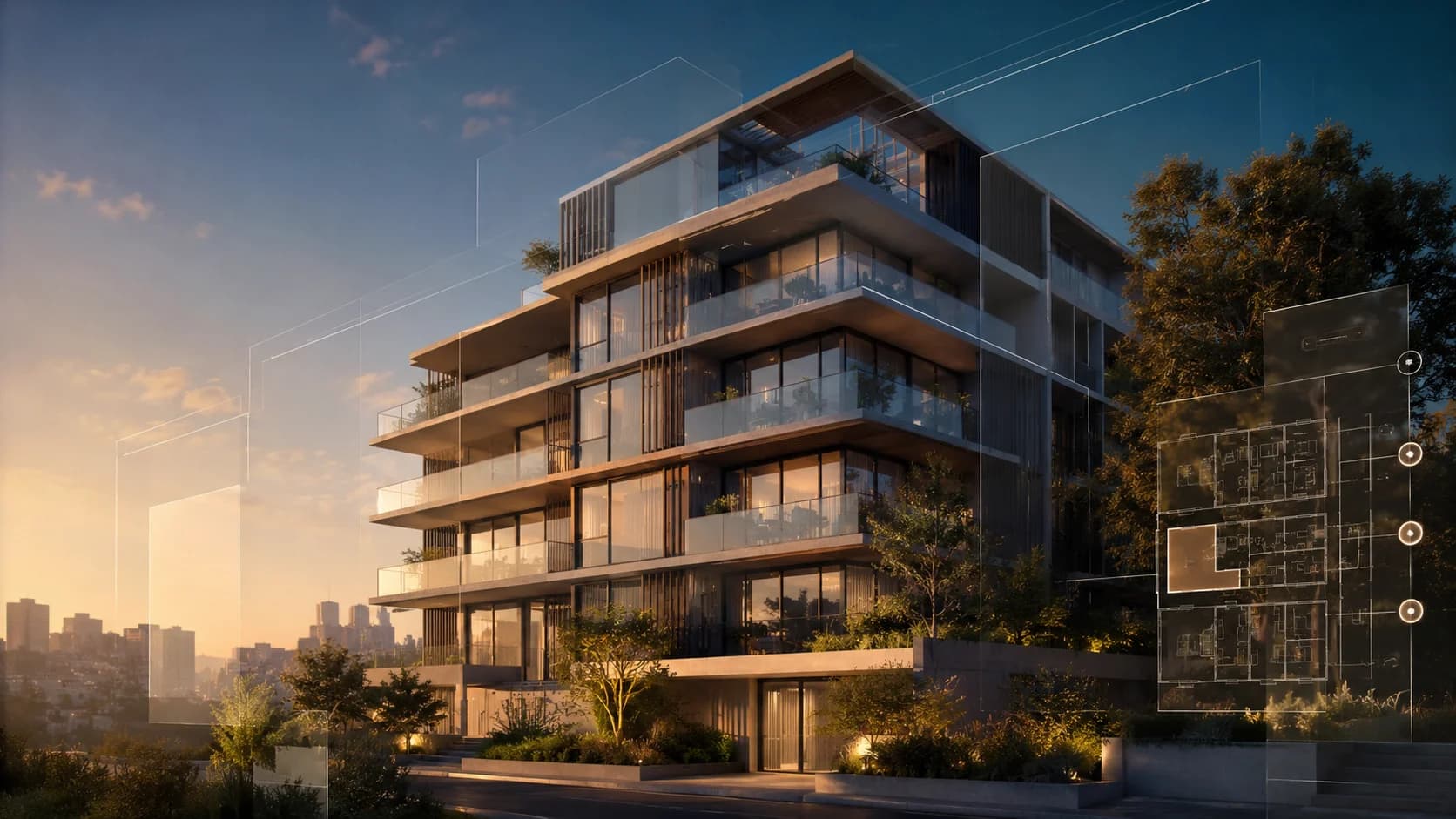
TL;DR. A virtual real estate showroom is a digital environment where buyers explore a project, browse units, check availability, and submit inquiries — all within a single, coherent experience. It is not a website, not a 360° tour, and not an interactive brochure: it integrates all those pieces in one place. In pre-construction projects, where buyers have nothing tangible to see, the virtual showroom has become the central tool for shortening the sales cycle and sustaining a premium perception. This guide covers the existing types, what a working showroom must include, how it integrates with the sales team, and when it makes sense to have one. Flowing appears as a category reference throughout.
What a virtual real estate showroom is — and what it isn't
A virtual real estate showroom is a digital environment where a buyer enters to explore a project before it is built. It is not an image catalog or a standalone 3D viewer: it is an experience where the project's commercial, visual, and operational information coexist in a single place.
Flowing's operational definition is simple: a virtual showroom is where the buyer explores the project, browses units, checks availability, and inquires, without jumping between disconnected PDFs, spreadsheets, videos, and forms.
It's worth distinguishing it from things often confused with it:
It is not the project's website. A corporate website describes the development; a showroom lets you walk through it. The difference is active vs. passive.
It is not a 360° tour. A 360° tour is one piece of the showroom (the immersion inside a unit), not the showroom itself. An isolated 360° tour leaves the buyer without context of the building, without availability, and without navigation between units.
It is not an interactive brochure. An interactive brochure organizes information in layers, but it remains a document. A showroom is an environment.
It is not an animated render. An animated render is passive content; a showroom is navigable — the buyer decides what to see.
The distinction matters because it defines what problem it solves: the virtual real estate showroom is the tool that replaces today's fragmented method (renders on one side, floor plans on another, availability in a separate spreadsheet), not just another piece added to the existing fragmentation.
Why it has become central to selling pre-construction projects
When selling a finished apartment, the buyer decides with all five senses: they walk, look, listen to the neighborhood. In pre-construction sales, the buyer signs a contract for something that does not yet exist. The only tangible elements are the contract, the price, and the developer's promise.
That turns visual presentation into the most important commercial asset of the project. It is not an aesthetic complement: it is what the buyer is actually buying, long before the first installment.
Data from the market backs this logic. Pre-construction purchases typically require down payments of around 40% of the total price, with the remaining 60% financed in installments adjusted by the Chamber of Construction (CAC) index over 24 to 30 months. In other words: the buyer commits to a medium-term financial decision based largely on how the project was presented to them.
Early units sell cheaper to attract early buyers who finance construction, and prices rise as construction advances. This means the absorption rate is not just a commercial indicator: it is what defends the developer's margin. When presentation is ambiguous or fragmented, the rhythm breaks, prices stagnate, and the project enters a difficult-to-reverse spiral.
This is where the virtual real estate showroom becomes central: it turns an intangible promise into a concrete experience. The buyer enters, explores, understands, and arrives at the sales conversation with closing questions, not explanation questions.
Types of virtual showroom: 3D, immersive, interactive, online
Industry vocabulary is often used interchangeably, but the terms describe different things. Understanding them is essential to evaluating market proposals.
3D showroom
Refers to visual quality: the showroom's content is generated in three dimensions, with photorealistic renders and precise modeling of the building and units. This is the minimum baseline today. A showroom without 3D content falls short of current buyer expectations.
Immersive showroom
Refers to the sensation of being inside. A showroom is immersive when transitions feel cinematic, when the user perceives depth and scale, when visual quality sustains the project's aspirational positioning. Immersion is not a technical effect: it is what separates a premium experience from a merely correct one.
Interactive showroom
Refers to the visitor making decisions. They can choose which floor to view, which unit to explore, which view of the building to look at, which amenities to check. Interactivity is what differentiates a showroom from a video. In a video, the order is set by the director; in an interactive showroom, by the buyer.
Online showroom
Refers to the channel: it lives on the web, accessible from any browser, with no installation, no downloads. This is what makes it shareable via link, sendable through messaging apps, and indexable on Google. A showroom that requires installing something is not an online showroom.
Full virtual real estate showroom
A mature virtual showroom combines the four dimensions: photorealistic 3D content, immersive experience, interactive navigation, and frictionless online access. Flowing positions itself at this point, adding a layer almost no one else has in the market: real Google indexability at the unit level, meaning each unit of the project can appear in organic searches before the building even exists.
The operational difference between these terms matters when comparing proposals: a company can offer a "3D showroom" and deliver a render viewer without interactivity, or an "immersive showroom" and deliver a 360° tour without unit navigation. Asking for concrete definitions avoids expensive confusion.
What a virtual real estate showroom needs to actually work
A showroom that moves the commercial needle has seven non-negotiable elements. If any is missing, it leaves a gap that the buyer fills with doubts:
Exterior building tour. Multiple views (front, side, aerial) with cinematic transitions. The buyer needs to see the project in its physical context before entering a unit.
Floor navigation. A floor selector with floor plan and hotspots over each unit indicating commercial status (available, reserved, sold) in real time.
Complete unit file. Interior render, 2D technical plan, 360° tour when applicable, square footage, rooms, orientation, price, and status.
Real-time availability. What the buyer sees is what actually exists. Few things are more commercially costly than a unit shown as available that is already reserved.
Lead capture with attribution. Form per unit or general inquiry, with tracking of what each lead viewed before inquiring and attribution to the broker who brought them.
Project's own domain. The showroom lives at the development's own URL, not as a subpage of a generic platform. This sustains brand perception and the project's SEO.
Performance. Fast loading, transitions without buffering, consistent experience on mobile. Performance is the first thing the buyer perceives; if it's slow, everything else loses.
These seven elements make up the baseline Flowing implements by default for each project. The difference between a showroom that meets this list and one that doesn't is the difference between an effective commercial tool and an aesthetic piece the sales team never uses.
Virtual showroom vs. what was used before: the honest comparison
Developers evaluating a virtual showroom almost always ask the same question: "does it replace what I already have?". The honest answer is that it replaces some things and integrates with others.
What it replaces:
Static PDF brochures. The brochure becomes obsolete the day a price changes. The showroom updates from a backoffice.
Excel availability spreadsheets. Commercial status lives in the same place as the visual material, not in a parallel file that gets out of date.
Loose renders shared by messaging app. The isolated render loses context. Inside a showroom, the render is understood within the project.
What it integrates with (not replaces):
Human sales team. The showroom prepares the conversation; it does not eliminate it. The broker arrives at an inquiry with a buyer who already understands the project.
Site visits when applicable. In later stages, the physical visit remains part of the close. The showroom does not compete with that — it precedes it.
Brand and campaign videos. A campaign video lives on social media and advertising. The showroom is the destination that video leads to.
The distinction matters because it dissolves a common fear: that adopting a virtual showroom forces throwing away everything already in place. It doesn't. The showroom builds on existing assets (when they're good) or replaces them with better ones (when needed).
How it integrates with the sales team (brokers, sales)
The most common operational objection from developers is: "will my brokers use it?". The short answer is that the broker does exactly what they already did, but better.
The broker today sends a PDF of renders to the buyer via messaging app. With a virtual showroom, they send a link. Same gesture, different content. The difference for the broker is that this link:
Automatically attributes the lead. Each broker has a tracking code. When a buyer enters through a broker's link and inquires, that inquiry is attributed to that broker without later discussion.
Provides inquiry intelligence. The broker knows which unit the lead viewed before inquiring, how long they stayed, what they downloaded. The conversation starts informed.
Generates downloadable unit files. If the buyer wants to keep material on a specific unit, the showroom generates a PDF with a QR code that returns to the full tour. The piece circulates on its own and brings the buyer back to the showroom.
Keeps availability updated. The broker doesn't send files for units that have already sold because the system updates itself.
The result: the broker perceives the showroom as operational relief, not a new tool to learn. At Flowing, brokers who tried the system have in several cases been the ones who pushed the developer toward adopting it.
When a virtual showroom makes sense (and when it doesn't yet)
A virtual real estate showroom doesn't apply to every project. It's worth being clear about when it does and when it doesn't, because the decision depends less on project size and more on the underlying commercial logic.
It makes sense when:
The project sells pre-construction (the showroom is more decisive the less there is to physically see).
There are multiple units or unit types that need to be presented comparably.
The ticket per unit is high: the more each closing is worth, the more it justifies premium presentation.
The development's brand matters to the buyer's decision.
The sales team works with external brokers who need shareable material.
It doesn't (yet) make sense when:
The project has a single unit or very few, all identical.
The ticket per unit is low and the economics don't justify presentation at this level.
The project is already finished and sells through direct site visits.
The commercial strategy doesn't contemplate pre-sales and the developer prefers to wait for advanced construction.
These criteria are honest for a concrete commercial reason: applying a virtual showroom to a project where it doesn't add value ends up disappointing the developer and weakening the category. It's better to rule out poor fits upfront.
What a well-built virtual real estate showroom looks like: the Flowing approach
Flowing is a virtual real estate showroom developed by LZ Render, a studio specialized in architectural visualization. The proposal has three particularities worth describing, because they define what kind of result it delivers:
Integrated production. The team that produces the project's renders is the same team that produces the showroom. This eliminates the usual market fragmentation, where one company makes the assets, another builds the website, and a third hosts everything. One vision, from the first render to the finished showroom.
Each project on its own domain. The showroom doesn't live as a subpage of a generic platform. It lives on the project's own domain, with managed SSL, indexable on Google. The buyer arrives and feels they're on the development's official site, not on an outsourced tool.
Google-indexable at the unit level. Unlike typical 3D showrooms (which are invisible to search engines), Flowing renders project information in a way that allows each unit to appear in organic searches. When a unit sells, it is automatically de-indexed.
The service includes complete visual production, showroom implementation, first-year hosting and domain, and an operational backoffice from which the developer manages availability, prices, statuses, leads, and construction progress without depending on anyone.
For concrete commercial conversations about specific projects, the Flowing team builds tailored proposals based on the development's scale and characteristics.
Frequently asked questions
What's the difference between a virtual showroom and a 360° tour?
A 360° tour is one piece of the showroom: immersion within a unit or space. A virtual showroom is the complete environment that includes the exterior building tour, navigation between floors and units, commercial availability, lead capture, and, within that, 360° tours when applicable. Having just an isolated 360° tour leaves the buyer without context of the full project.
Does it work for small projects?
It works for projects where the ticket per unit justifies premium presentation, not based on number of units. A boutique building of 6 to 8 units with a high ticket can benefit as much as a 100-unit development. The criterion isn't scale but average ticket and target brand value.
Does it replace the broker or the sales team?
It doesn't replace them, it prepares them. The buyer arrives at the commercial conversation already understanding the project, with closing questions instead of explanation questions. The sales team also receives intelligence about the lead's previous behavior, allowing them to start the conversation with context.
How long does it take to be ready?
It depends on the state of the project's visual assets. If the developer already has good-quality renders and 3D modeling, timelines are shorter. If Flowing produces the assets from scratch, the process takes longer but guarantees full visual coherence. The team builds a specific timeline per project.
Does it work on mobile?
Yes, the experience is adapted for mobile with floating controls specific to touch screens. It's a central consideration because more than half of real estate project traffic comes from mobile. A showroom that doesn't work well on mobile loses the majority of inquiries.
What happens when a unit sells?
The sales team updates the status from the backoffice and the unit appears as reserved or sold in the showroom in real time. Additionally, if it was indexed on Google, it is automatically de-indexed so that inquiries don't come in for something that's no longer available.
Read next
Why an Integrated Solution Outperforms a Standalone Platform in Real Estate Project Presentation