Thinking about the unbuiltOur blog
Interactive 3D Showroom vs. Standalone Renders: What Works Better for Presenting a Real Estate Development
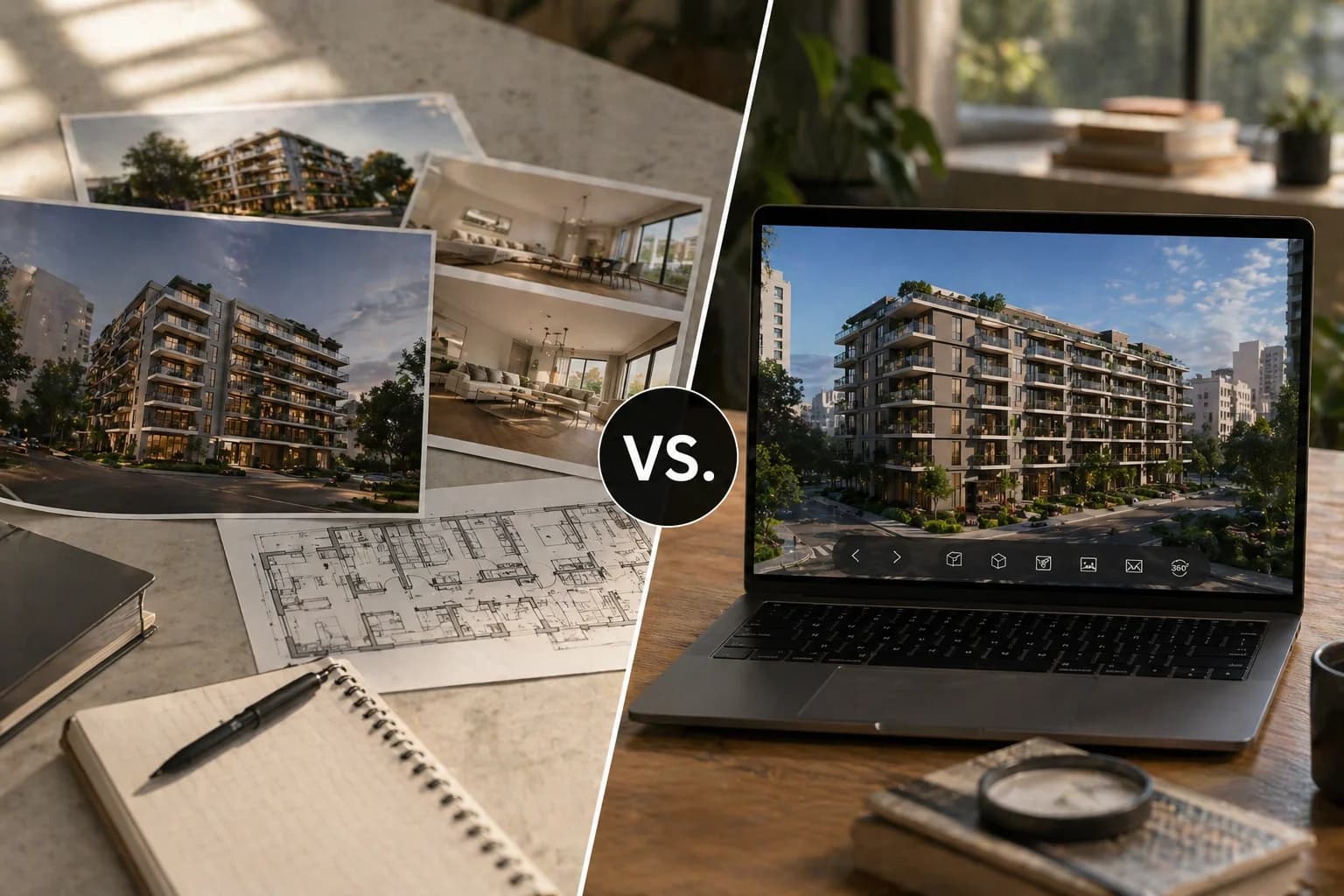
Renders remain one of the most important assets in real estate marketing. They help create desire, elevate the perceived value of a development and communicate atmosphere, materials and design. But when they are used alone, they have a clear limitation: they show, but they do not always help people understand.
That is where the interactive 3D showroom comes in.
The difference between the two is not only visual or technological. It is commercial. A standalone render can create immediate impact. An interactive 3D showroom can combine visual impact with navigation, context and relevant information inside the same experience.
Standalone renders are still useful
It would be a mistake to frame this comparison as if renders no longer mattered. They are still essential to the presentation of a development.
They work especially well for:
launch campaigns
brochures
social media
sales materials
building perceived value
The problem appears when the entire project depends only on those assets. Because seeing an attractive image is not the same as understanding how a development actually works as a whole.
What an interactive 3D showroom adds
An interactive 3D showroom does not replace the render. It integrates it into a broader logic.
Instead of presenting isolated assets, it organizes an experience where the user can:
view the project from multiple perspectives
navigate floors
explore units
check availability
access floor plans
switch viewing modes
generate contact from the same environment
That completely changes the way the development is presented and understood.
Showing is not always the same as explaining
This is the central point.
A strong render can create emotion. An interactive showroom can create emotion and also organize the understanding of the project.
That becomes especially important in developments with multiple layouts, different unit configurations or early-stage sales, where buyers need to interpret something that does not physically exist yet.
When the experience is well resolved, users do not have to mentally assemble the development from separate pieces. They can move through it in a more fluid and coherent way.
The problem with fragmentation
One of the main limitations of relying only on standalone renders is fragmentation.
The user receives one image in one place, a floor plan somewhere else, availability in a separate table and contact information in another place. Even when each element is correct, the overall experience becomes broken.
An interactive 3D showroom offers the opposite: a unified experience. And that unification is not just a visual detail. It has real commercial value.
The clearer the project becomes, the easier it is to compare, value and move forward in a commercial conversation.
When each option makes sense
Renders may be enough when:
the project is simple
you need a specific communication asset
commercial complexity is low
there is no need to show multiple layouts or routes
An interactive 3D showroom becomes more valuable when:
there are multiple units or floors
the project is being sold pre-construction or during construction
the sales team needs a stronger presentation tool
the development competes in a premium segment
presentation is part of the project’s perceived value
The smartest decision is not always choosing one over the other
In many cases, the smartest decision is not choosing renders or showroom, but integrating both under the same visual and commercial logic.
Renders remain the aesthetic core of the presentation. The showroom adds structure, navigation and continuity. Together, they can create a much more powerful experience.
Conclusion
The real comparison is not between attractive images and technology. It is between a fragmented presentation and a better resolved experience.
Standalone renders are still valuable, but an interactive 3D showroom can take the commercial presentation of a development to a much clearer, more complete and more effective level.
When the goal is not only to impress, but also to explain and sell more effectively, the showroom begins to play a clearly stronger role.
Read next
How a 3D Real Estate Showroom Helps Sell Pre-Construction Projects with More Clarity and More Value